


Introducing frugal innovation, then tracing who creates value, who captures it, and who carries the risk

Photo by Joe Dudeck on Unsplash
A rusted metal container stencilled with the words “Safety First”, the paint weathered and peeling away.
Frugal innovation is often introduced through an irresistible promise: doing more with less. In places where income, infrastructure, expertise or formal services are scarce, that promise can be transformative. A basic mobile phone can become a bank branch. A compact diagnostic device can bring cardiac testing closer to rural patients. A radically simplified car can make four-wheeled mobility accessible to families previously priced out.
But the phrase “more with less” contains a question that is too easily left unasked: less of what? Sometimes the answer is fewer non-essential features, lighter materials, simpler interfaces or a more efficient distribution model. Sometimes, however, the margin removed is also a buffer against failure. The saving can reappear elsewhere as exposure to injury, fraud, breakdown, administrative burden or insecurity. Frugality does not make cost disappear; it may redistribute cost and risk across an innovation ecosystem.
Our argument: A frugal innovation should be judged not only by what it makes affordable, but also how it distributes value and vulnerability. We ask: who creates value, who captures value, and who carries the risk when the system fails or is exploited?
What counts as frugal innovation?
There is no single uncontested definition of frugal innovation; however, this concept originally emerged in the context of developing nations and emerging markets. The main idea was to create products, services, or business models that target non-affluent customers typically left underserved by conventional innovation. A useful starting point comes from Weyrauch and Herstatt’s review of the literature and interviews with practitioners. They identify three defining criteria: substantial cost reduction, concentration on core functionalities, and optimised performance level. The last criterion matters. Frugal does not mean cheap, stripped-down or improvised; performance must remain appropriate to the purpose and to local conditions. More recent critical reviews make the same point: affordability alone is not enough if a solution no longer meets an acceptable quality or performance threshold.
Frugal innovation responds to resource constraints by rethinking a product, process, service or business model around its core function, and recent growth in this phenomenon has seen its application even in developed countries. A frugal innovation may be developed by a multinational company, a local enterprise, a public institution, a community, or an individual. It may be high-tech or low-tech, formal or grassroots, physical or digital. Context matters: what is “core” and what counts as “optimised” will differ between a car, a machine and a payment platform.
Three familiar examples
M-PESA is a strong example of frugal innovation. Launched in Kenya by Safaricom, the country’s leading mobile operator, the platform enables users to conduct financial transactions via their mobile phones and a distributed network of local agents. Its frugality lies not only in the technology but also in the business model: rather than building conventional bank branches, it leverages existing mobile infrastructure, a simple user interface and neighbourhood cash-in/cash-out points. It is now a crucial component of many businesses' supply chains in Kenya. M-PESA combines technological, social and institutional innovation.
In Vietnam’s Mekong Delta, agricultural drone spraying has scaled at remarkable speed: adoption among rice smallholders jumped from roughly 30% of households in 2023 to 80% in 2024. The frugality lies less in the technology than in the delivery model. Farmers do not buy drones; they buy spraying as a service from local cooperatives and individual entrepreneur pilots, extending a long tradition of outsourced farm tasks. Notably, this happened without any “Uber-for-drones” platform — a state-run service was discontinued for lack of demand, and the one digital platform that emerged went bankrupt. The market runs instead on direct, local relationships.
In the context of local scrap dealers on the back side of Agbogbloshie, one of the world’s largest e-waste dump sites in Ghana, we find frugal innovation. Here, an estimated 10,000 to 30,000 informal actors dismantle electronic waste from all over the world and process it by burning, melting, and casting into new products such as cast iron posts for cooking household or street-side meals, metalwork, and roofing sheets for the local construction economy. The frugality observed here lies in the processes and activities undertaken, as identified by Ludeke et al. (2020), and is also evident in the business model for sustainable innovation. Hence, frugality is not observed only in the outcomes of products and services produced but in the processing of waste into products through recycling, repurposing, and refurbishing. Through the activities of informal scrap dealers, they fulfil the required tenets of frugal innovation: reduced input costs and a focus on delivering a core functional product that performs reliably.
What do safety and security mean here?
For this discussion, safety concerns unintended harm when an innovation fails, underperforms or is used in foreseeable conditions. It includes physical injury, health harm, financial loss and operational failure. The practical safety question is: who can be hurt on the bad day, and what safeguards stand between a fault and that harm?
Security concerns focus on protection against deliberate threats or exploitation. This includes robbery, fraud, corruption, counterfeit inputs, identity theft, data exposure, and coercion and manipulation of a system’s vulnerabilities. The practical security question is: who can exploit the innovation or its ecosystem, and who becomes exposed when they do?
The distinction is useful, but the categories overlap. A stolen phone can pose a financial safety risk; weak customer support can turn a user error into an unrecoverable loss; a cash-heavy agent network can make digital inclusion depend on workers who face physical violence. We therefore treat safety and security as a single distributional lens: where are vulnerabilities located, which actors have the capacity to prevent or absorb them, and which actors are left to bear them?
A sharper lens: Frugality is not inherently unsafe by definition. The concern is mismatch: benefits may be widely celebrated or centrally captured, while safeguards, recovery work and losses are pushed towards actors with the least power to absorb them
Case 1: M-PESA – financial inclusion built on distributed risk
M-PESA has scaled rapidly, with over 7 million users by 2009 following its launch in 2007. Its core function is easy to see: users can send, receive, and store money without travelling to a conventional bank branch, and pay for goods and services; households can support relatives over a distance, and small businesses can transact quickly. M-PESA operates on electronic money (e-float), a digital value equivalent to cash stored in users’ accounts. This e-float can be transferred between users via SMS or converted back into cash through Safaricom’s extensive network of more than 23, 000 agents across Kenya. Peer-reviewed research links mobile money to lower transaction costs, improved risk sharing and expanded financial inclusion, while also warning that access and use remain unequal.
Who created and captured value?
Value was co-created across an ecosystem. Vodafone and Safaricom developed and operated the platform. Regulators created an enabling environment. Banks held trust accounts. Agents invested capital, managed liquidity, verified customers, handled cash and translated the service for users. Customers did more than consume: their practices during pilots helped reshape the service from a microfinance repayment tool into person-to-person money transfer. Their trust and network effects made the platform valuable.
Value capture is more concentrated. Safaricom captures transaction and platform revenue and gains strategic power from network sales. Agents earn commissions, though these must cover rent, staff, liquidity and security costs. Users capture convenience, time savings, reduced travel and access to transfers; merchants and adjacent financial providers capture new payment and credit opportunities. Government captures taxes and gains a more legible financial infrastructure. This distribution is not inherently unfair; platforms require revenue to survive, but it becomes problematic when extraction grows without proportional investment in the people and safeguards that keep the system functioning.
Who carries the risk – and what risks?
Users carry transaction and recovery risk. A mistyped number, a misleading prompt, fraud or unauthorised access can move money instantly. The system’s speed is part of its value, but it narrows the window for correction. The loss is not only the amount transferred; it also includes airtime, travel, repeated calls, documentation, and time spent navigating customer care. Research focused on M-PESA’s customer care reports that there is room to improve operations, segmentation, and the use of field agents, particularly for low-income customers. When a reversal or complaint becomes difficult, the administrative burden falls most heavily on users for whom even a small loss matters.
Agents carry liquidity, fraud, and physical security risks. To make a digital platform usable, they must handle both cash and e-float. This creates an operational balancing problem and makes them a visible target for theft, robbery and counterfeit notes. A recent incident in Meru illustrates this exposure: individuals posing as customers allegedly asked to exchange foreign currency at an M-PESA shop and, after engaging the attendant, reportedly stole more than KSh40,000. Police linked the suspects to similar incidents targeting mobile-money operators in several Kenyan towns. Agents must therefore assess unfamiliar customers and detect possible deception while simultaneously performing identity checks, managing transactions and troubleshooting at the boundary between formal rules and local relationships. Their everyday labour and the physical insecurity that accompanies it are part of the hidden essential infrastructure that makes M-PESA’s accessibility possible, yet some scholarship describes them as “human ATMs” whose relational and affective work is captured by the platform. Metal bars, restricted openings, and private guards are not peripheral details; they are evidence that part of the cost of inclusion has been shifted to frontline security arrangements.
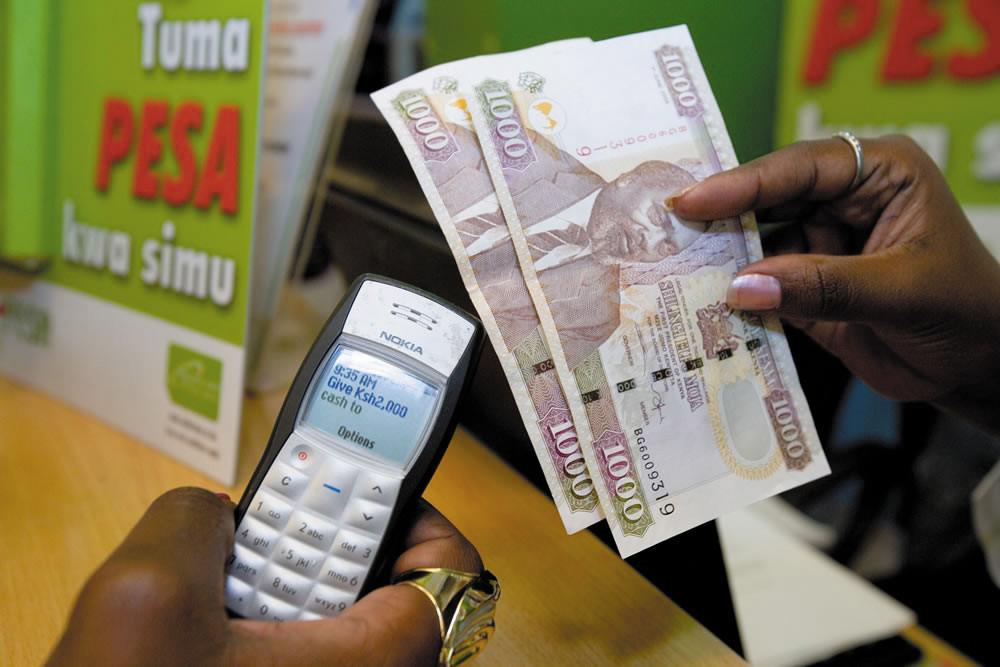
Photo by Rosenfeld Media on Wikimedia Commons · CC BY 2.0
A person holds a Nokia 1100 showing an M-PESA cash transfer prompt while counting Kenyan shilling notes at an agent counter.

The platform and public institutions bear systemic responsibilities but can shift some of those risks downstream. Safaricom faces fraud, outage, reputational and compliance risks; regulators face the challenge of protecting users without undermining the simplicity that enabled adoption. The government is also a value-capturing actor. Kenya’s excise duty on financial transaction fees, including mobile money, illustrates how a successful frugal innovation can become a revenue base. Tax is not inherently corrupt or illegitimate: public revenue can fund the infrastructure and security on which the ecosystem depends. The governance question is whether taxation is proportionate, transparent and accompanied by public value, or whether it raises the cost of inclusion while agents and users continue to finance protection and recovery themselves.
Case 2: Agricultural drones in the Mekong Delta — speed against a moving safety line
Drone adoption among Mekong Delta rice smallholders jumped from roughly 30% of households in 2023 to 80% in 2024. As with M-PESA, the frugality here lies less in the technology than in the delivery model: farmers don't buy drones; they buy spraying as a service from local pilots and cooperatives, extending a long tradition of outsourced farm labour rather than requiring new ownership or capital. Notably, this scaled without any "Uber-for-drones" platform; a state-run service was discontinued for lack of demand, and the one digital intermediary that emerged went bankrupt. The market runs on direct, local trust rather than a formal booking or verification layer, which is precisely where the risk below lies.
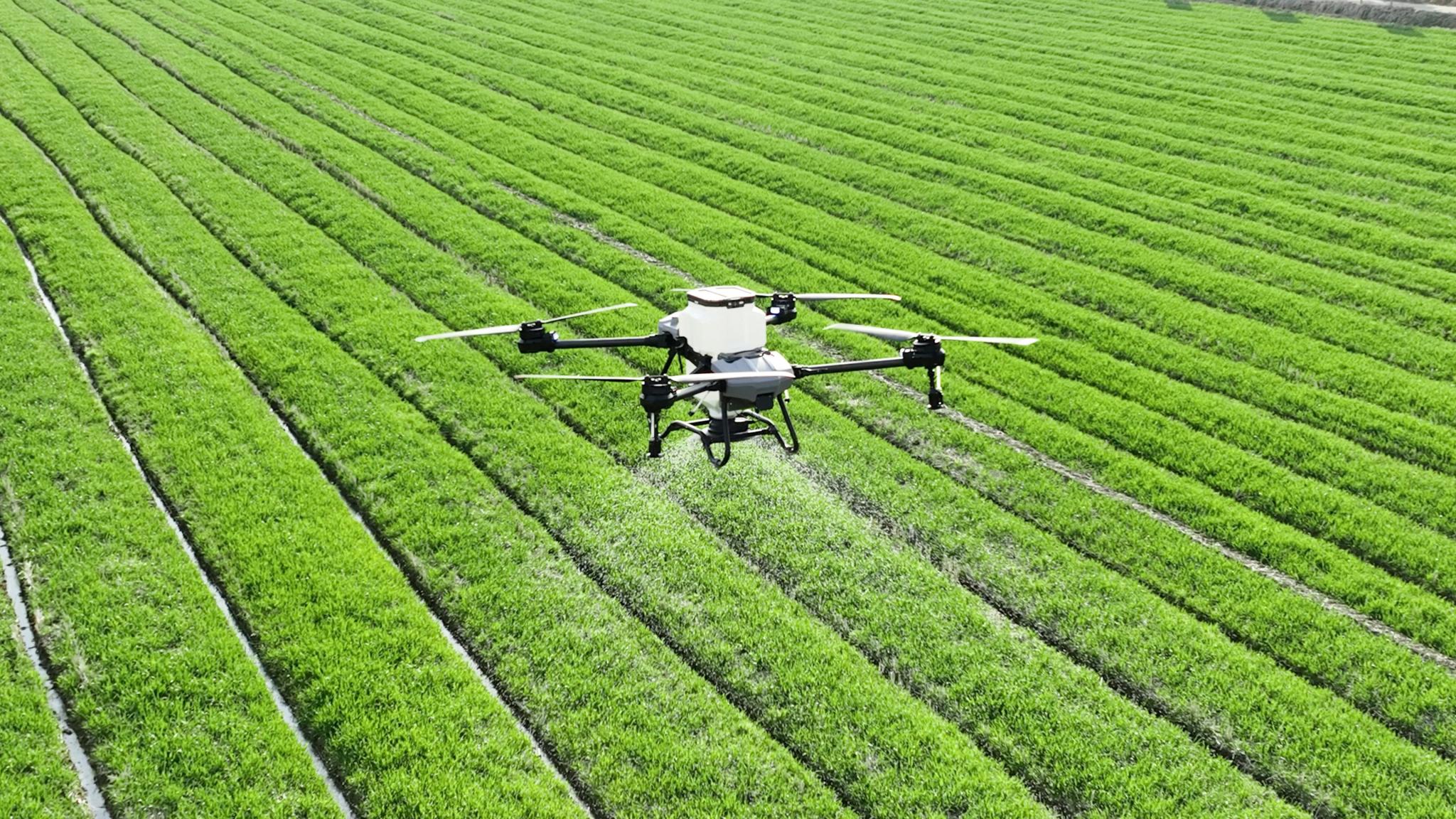
Photo by DRONE EFT on Unsplash
An agricultural spraying drone flying low over rows of green rice paddies in Vietnam.
Who created and captured value?
Manufacturers and dealers supplied hardware; the state seeded early demand through cooperative subsidies; pilots invested capital and training; and farmers supplied both demand and the trust that let a service model function without a platform underwriting it. Capture splits along the hardware/service line; most drones are imported, so a substantial share of value leaves the delta. With no surviving platform, no intermediary skimming transaction fees, and no operator accumulating farm data, a rare case where the absence of a "successful" platform kept value comparatively local.
Who carries the risk?
The risk isn't hypothetical. In November 2024, a spraying drone in Hòn Đất, Kiên Giang, collided with a pedestrian and killed him. A separate report on the same incident describes the victim being slashed in the head and neck by the rotor. Regulatory gaps compound the risk: as one drone owner put it, "As long as you have money to buy a drone, you can become a pilot", and officials warn that some pilots "fly recklessly, returning too quickly without proper observation" despite training on safe landing sites. A farmer on the dike cannot verify dosage or coverage; trust in a known pilot serves as a substitute for formal quality assurance.
The same trade-off shows up outside agriculture. In conversation, Lam Hai Dung, who works in wood pellet exports, described how port demurrage costs push factories to load pellets before they've properly cooled — shipping on time wins over the margin that guards against self-heating and combustion in transit. It's the same structural bargain compressed into minutes over a rice field instead of days at a port: the cost of the delay is real, so the safety buffer is the thing that gives.
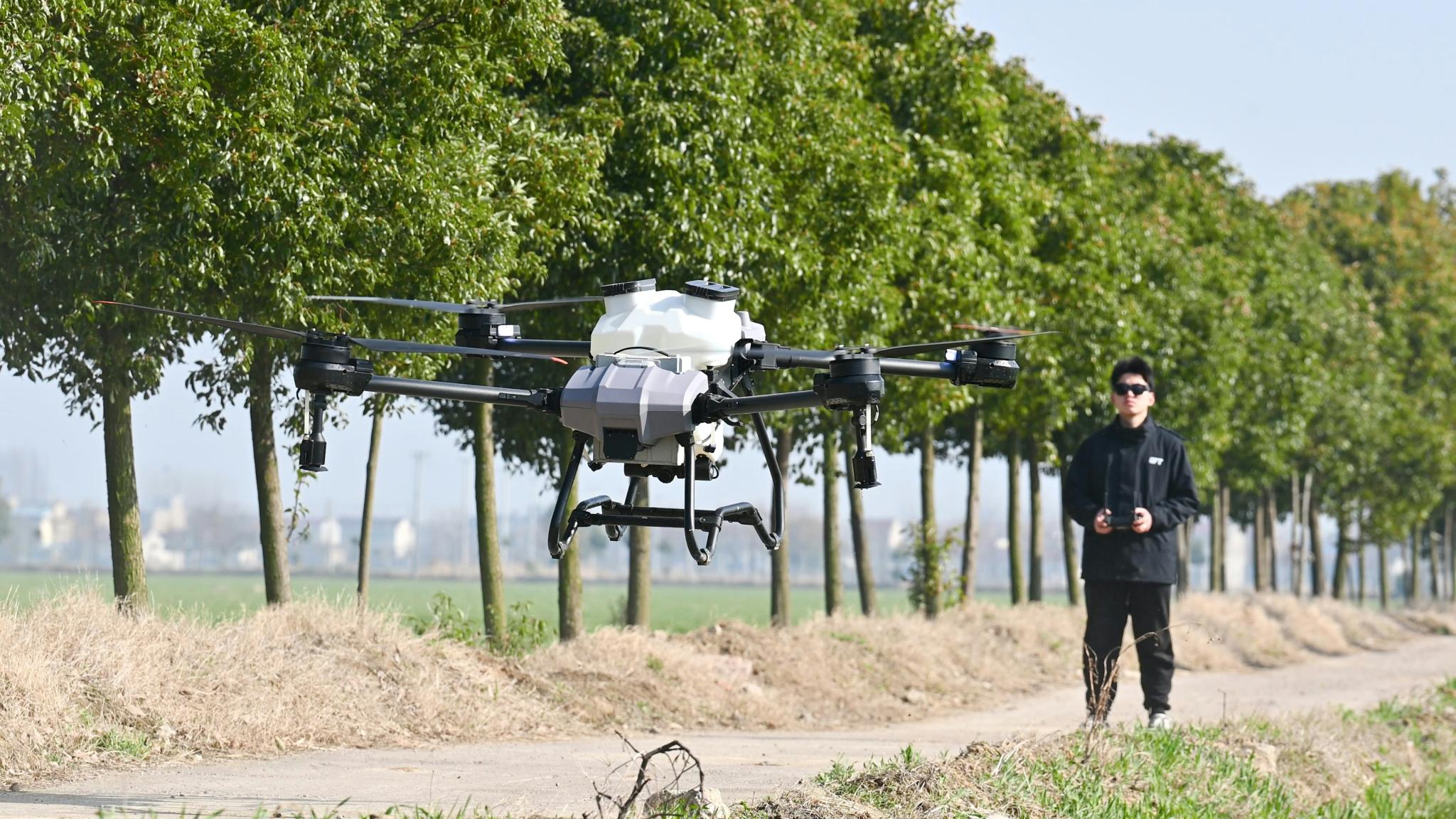
Photo by DRONE EFT on Unsplash
A man operates a remote control as an agricultural drone hovers above a rural roadside lined with trees.
Neighbours carry drift exposure onto adjacent plots and fish ponds without ever being party to the transaction. And as drone flight data increasingly logs to manufacturers' cloud platforms, the data-exploitation risk the failed local platforms avoided may be returning through the hardware itself.
Case 3: Ghana's Informal E-Waste Economy
In the back of Agbogbloshie, one of the world's largest e-waste processing hubs in Accra, Ghana, an estimated 6,000 to 30,000 informal actors dismantle electronic waste from across the globe, processing materials by burning, melting, and casting them into new products. These activities produce cast-iron cooking pots for household and street-side meals, metalwork, and roofing sheets for the local construction economy. This is frugal innovation in practice, not merely in the outcomes of products and services, but in the very processes of recycling, repurposing, and refurbishing waste into valuable goods.
The frugality observed here aligns with the framework by Lüdeke-Freund et al. (2024) on business models for sustainability. Informal scrap dealers fulfil the core tenets of frugal innovation: reduced input costs, a focus on delivering core functional products that perform adequately, and resource optimisation born of necessity. However, as noted earlier in this piece, value creation, retention and capture consider appropriate safety standards and support mechanisms essential to ensure they do not unintentionally pose risks to the communities they are designed to serve. We examine this case study to dissect whether the presence of frugal innovation does that.
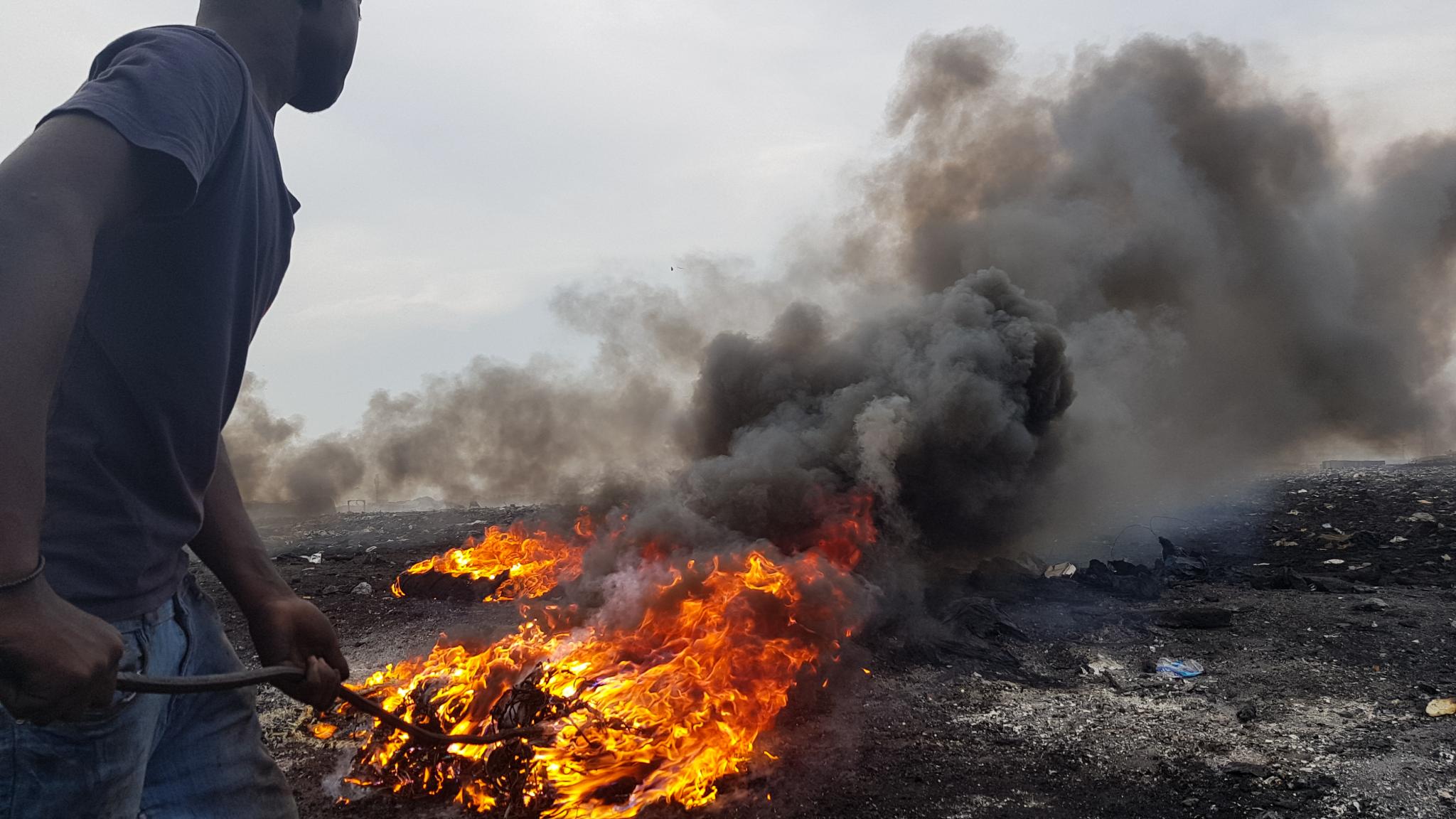
E-waste site in Accra, Ghana. Photo by Synth85 on Wikimedia Commons
A worker uses a metal hook to tend a fire of burning cables at the Agbogbloshie e-waste site in Accra, with thick black smoke rising behind him.

Who created and captured value?
The Informal Workers: The Human Infrastructure of Value
Value in Agbogbloshie is-created through a distributed network where informal workers form the essential human infrastructure. Workers perform multiple roles: collectors, dismantlers, burners, repairers, and aggregators, often combining several functions to sustain livelihoods. These actors transform discarded electronics, much of it shipped from the Global North as "second-hand goods" or "recyclables" , into valuable materials and products.
Their activities include material recovery by extracting copper, aluminium, and other valuable metals through manual dismantling and open burning; repair and refurbishment to extend product lifecycles through repair and resale, creating what scholars describe as "alternative value regimes" oriented to use-value and collective survival ; and re-manufacturing such as casting recovered metals into new products such as cooking pots, roofing sheets, and metalworks for local construction (Oteng-Ababio et al, 2016).
The Broader Ecosystem: Interdependent Value Creation
Value creation extends beyond the workers themselves. The ecosystem includes global supply chains through which an estimated 150,000 tonnes of e-waste are shipped to Ghana annually, both legally and illegally. The global circular economy depends on this end-of-life processing, yet the environmental and social costs are externalised to the Global South. Also, there are the intermediaries such as local scrap dealers who purchase extracted materials, creating a bridge between informal recovery and formal markets. These intermediaries profit from the price differential between what they pay workers and the international market rate for recycled minerals. Additionally, local communities where e-waste sites are provide an ecosystem of services-housing, services, and social networks that enable workers to survive. However, community members also bear the environmental burden, as toxic smoke and particulate matter spread across nearby settlements.
Who Captures Value? Concentrated Capture in a Distributed System
While value is co-created across a distributed network, value capture is significantly more concentrated—a pattern that mirrors the M-PESA case.
Intermediaries and Formal Firms capture the largest share of economic value. Exporters buy recycled minerals like copper at prices well below international market rates. The difference between what workers are paid and the global market price represents a transfer of value from labor to capital. Formal firms also benefit from access to materials without bearing the costs of environmental remediation or worker protection.
Government captures value through taxation and regulatory control which largely impacts the formal firms that are easily recognisable in their system. For the informal operators, literature reports series of harassment by local authority agents for bribes due to to the fear of operating outside legal bounds (Njoku et al, 2023). While Ghana has ratified international conventions and passed the Hazardous and Electronic Waste Control and Management Act (Act 917) in 2016, enforcement remains weak. However, the state also benefits from the economic activity—an estimated US$105-268 million annually generated by the informal e-waste economy (Daum et al, 2017)—without providing corresponding public goods such as health services or safe infrastructure.
Workers Capture Minimal Value. Despite being essential to the entire system, workers earn meager returns. Many earn less than US$1.25 per day. However, according to Oteng-Ababio et al, 2016 and SRI baseline report, 2023, a few earn significant income, usually by years in the industry, scaling personal capital and employing others and establishing a network of clients. Overall, little income comes to the informal e-waste workers. This is not because their work lacks value—global e-waste stocks are estimated to be worth US$65 billion—but because the value they create is captured by those above them in the chain. Workers capture different forms of value like immediate income, livelihoods and social networks (Bimpong et al, 2024).
Global Consumers and Industries capture value through access to cheap recycled minerals essential for the green transition. Copper, aluminium, lithium, and cobalt recovered in Agbogbloshie feed back into global supply chains for electronics, batteries, and renewable energy technologies. Yet these beneficiaries do not compensate workers or communities for the environmental and health costs.
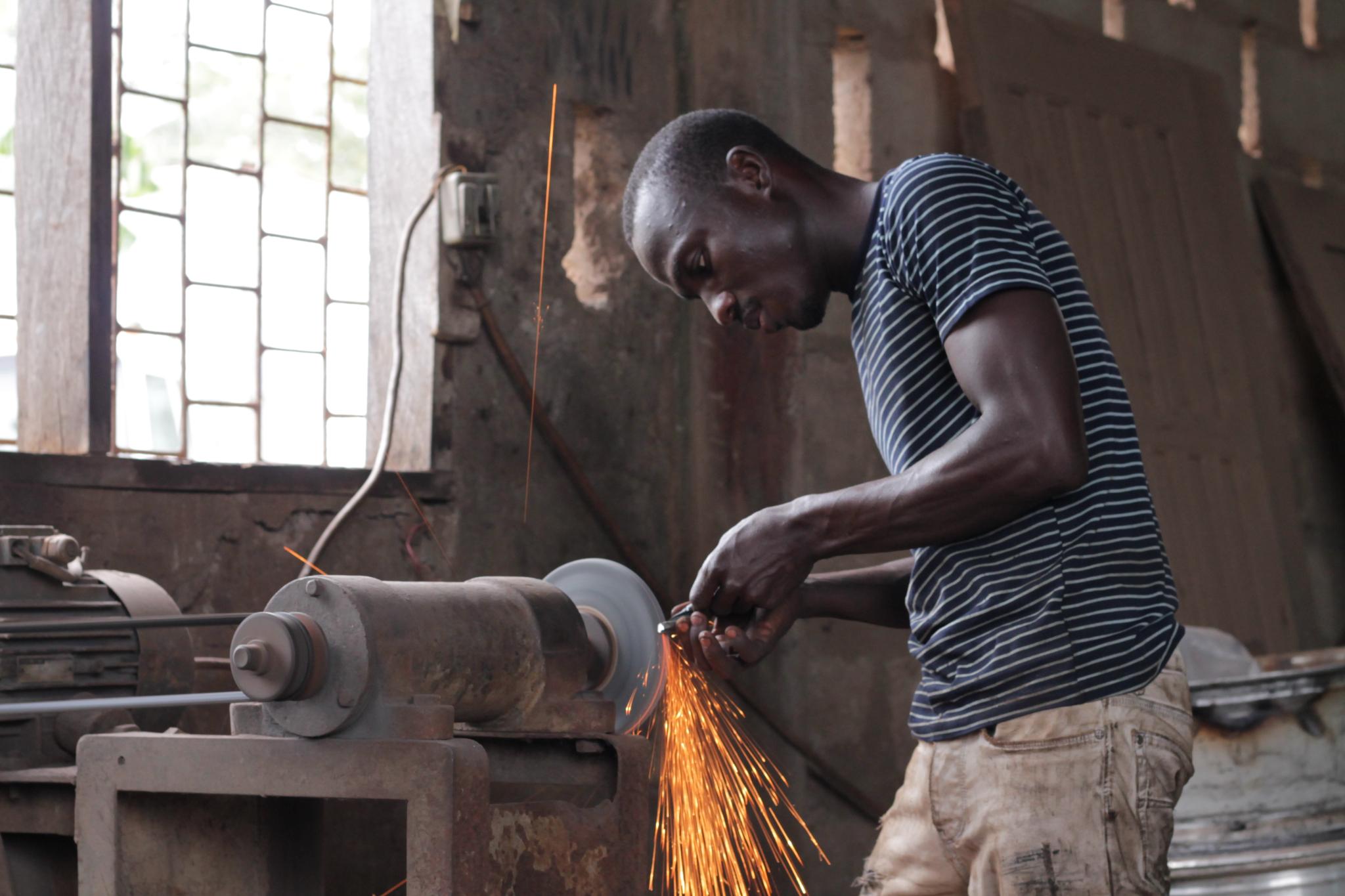
Metalworker in Ghana. Photo by Amuzujoe on Wikimedia Commons
A Ghanaian metalworker grinds a piece of metal on an unguarded bench grinder, sparks flying, without gloves or eye protection.

Who carries the risk – and what risks?
Workers Bear the Greatest Burden. Workers bear risks disproportionate to their returns, a pattern of "regulated informality" in which the state tolerates informal labour while withholding protection. These risks are identified in several forms -health risks, physical and security risks, being prone to cardiovascular disease and heart attack, burns, respiratory illnesses and lung conditions, nervous system damage, cancer and lead poisoning, with studies showing 77.7% of workers have pathological blood lead levels (Finn et al, 2025). Moreover, risks are disproportionately borne by stratified groups like children and lower-level workers. Across the board, risks are concentrated at nodes of transactions, with more gatekeeping done by brokers who control market access.
What the three cases reveal
In all 3 cases, a synonymous feature is the co-occurrence of the semblance of trust and risk, and their manifestation. In the case of M-PESA, trust in the service is managed locally by agents in communities who bear the greatest risk of attacks within the collective stakeholder group that includes the M-PESA corporation and regulators. Likewise, in the drone case, trust is managed relationally rather than institutionally: farmers hire pilots they know, and that personal trust substitutes for formal verification, while the heaviest risks fall on spray operators, who absorb concentrated chemical exposure and capital risk, and on neighbours, who carry drift exposure without any part in the transaction.
Lastly, informal e-waste dealers also pose the highest risks to the physical environment, handling electronics that process harmful chemicals. Additionally, they manage trust in the products they manufacture from their e-waste activities within the local economy; by relying on the trust relationships they forge, they pass the risk of their recycled products to their customers. Regulators, local government authorities, and development agencies carry less risk than the e-waste actors and their customers. A critical analysis of their capacity to absorb losses reveals they may not be able to do so.
Across all cases, the key analytical move is to stop treating “the innovator” and “the user” as the only actors. Suppliers, agents, regulators, banks, police, tax authorities, informal intermediaries and criminals can enter the ecosystem and change who benefits. Some actors are planned partners; others emerge only after scale creates new opportunities for extraction or exploitation. Corruption is one possible governance risk, but it should be evidenced rather than assumed. More broadly, institutions can enable, protect, obstruct or appropriate value from an innovation.
The question to carry forward: When an innovation removes a margin to become affordable, who supplies the missing buffer; through their labour, exposure, time, dignity, money or physical safety?
This framing keeps safety and security broad enough to capture the real ecosystem effects but focused enough to guide analysis. It does not demand that every frugal solution reproduce expensive conventional standards. It asks for safeguards that are appropriate to the context, independent testing where harm could be serious, accessible complaint and recovery channels, security support for frontline actors, and regulation that protects without making inclusive solutions impossible.
Conclusion
The three case studies exemplify how frugal innovation in informal contexts can create substantial value: economic, social, and environmental, while simultaneously concentrating capture and cascading risk onto those least able to bear it.
Value creation is widely distributed, relying on the labour, skill, and ingenuity of thousands of informal workers. Value capture is concentrated, with intermediaries, formal firms, government, and global industries capturing the majority of economic benefits while workers earn a fraction of the value they create. Risk cascades downward to workers, their families, consumers of frugal services and products-communities, who bear the health, environmental, and livelihood costs of a system from which they capture the least benefit.
The "informal paradox" described by Finn et al. (2025) captures this dynamic perfectly: "immediate need to survive replaces the need to avoid chronic threats to human and environmental health". Just as M-PESA's speed creates value but narrows the window for error, Agbogbloshie's informal processing creates economic opportunity but exposes workers to toxic pollution. The governance question is not whether frugal innovation is valuable; it clearly is, but whether the value captured by those at the top is proportionate to the risks borne by those at the bottom, and what interventions could make the distribution more just.
Some locally grounded safeguards already point towards possible answers. In Kenya, payment-service regulations require free complaint mechanisms, resolution within 30 days and recourse to the Central Bank, while M‑PESA’s reversal channel attempts to address mistaken transfers. At Agbogbloshie, interventions have included training in safer dismantling, a health clinic, cable-processing machinery that reduces the need for open burning, and incentives for directing hazardous materials to formal recyclers. These measures are imperfect, but they illustrate what context-sensitive support can look like: protecting users and workers without eliminating the accessibility or livelihoods that make the innovations valuable.
Appropriate safety standards and support mechanisms are essential to ensure frugal innovations do not unintentionally pose risks to the communities they are designed to serve. Without such interventions, frugal innovation will continue to produce value, but at a cost paid disproportionately by those who can least afford it.
About the authors
 Nana Yaa Korankyewa Ayim
Nana Yaa is a PhD candidate at Erasmus University with an interest in the circular economy (particularly as it concerns solid waste), the informal sector, and frugal innovation.
Previously, Nana Yaa was the Planning, Monitoring, and Reporting Officer for the Change Hub Global Team at IRC WASH, a global 'think and do' tank advancing systems strengthening in WASH. She has a previous Master's from KNUST, an MSc in Civil Engineering (Specialising in Water Supply and Environmental Sanitation). Her first degree is a BSc in Environmental Engineering. Her interests lie in educating Ghanaian youth, through STEM initiatives and empowerment sessions. Connect with her on LinkedIn here.
 Fisiwe Hlophe
Fisiwe Hlophe is an Industrial Engineer, currently pursuing her PhD in Industrial Engineering at Stellenbosch University in South Africa. Fisiwe is a member of the research group AFRIN – a collaborative research effort between Stellenbosch University, Leibniz University in Hannover, Germany, and the Indian Institute of Technology Madras (IITM). The group researches pathways for generating and scaling advanced frugal innovations (AFIs). Click HERE to visit her LinkedIn profile.
 Tharin van Niekerk
Tharin van Niekerk is a South African based in Hải Phòng, Vietnam, with qualifications in both English language teaching and hotel management. Two sectors, seven years, one constraint-driven market — that combination, and a short period living in the Netherlands where she first encountered frugal innovation, is what drew her to the field.