


Domain group: Digitization
Over eight weeks, VOICE brought together master students and practitioners from across the Global North and South to explore frugal and bottom-up innovation. As part of the programme, participants learned to write for a wider audience: getting an idea across quickly, clearly, and in their own voice. The blog below is the result, grounded in local conversations and shaped through weeks of collaborative writing.
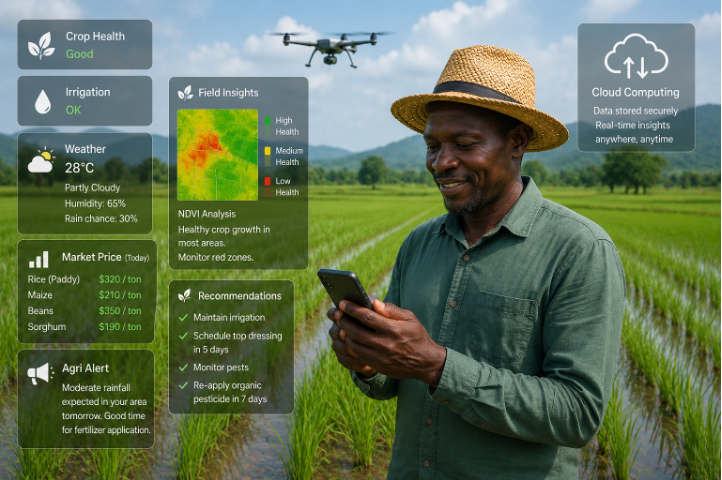
Source: AI generated
The recent expansion of digital agriculture for smallholder farmers, particularly in the Global South, has promised higher outputs, greater sustainability and improved market access. Pitch decks and fundraising proposals promote “climate‑smart” platforms that will revolutionise African agriculture with real‑time market prices, advisory services, weather alerts and credit—all at scale. Yet when you step away from the dashboards and listen to the lived experiences of smallholder farmers, a different story surfaces: stalled engagement, generic advice, and one‑way messages that arrive late or not at all.
Drawing on recent field research in Ghana and Kenya by Gatti and co-authors, our VOICE ethnographic conversations with Esoko users, and emerging evidence from tools such as Digital Green’s FarmerChat, Wadhwani’s CottonAce, and Pula’s pay‑at‑harvest crop insurance, we argue that Ag‑tech platforms need a frugal innovation lens to make an impact in the everyday lives of smallholders. Frugal innovation is not about doing digital agriculture “on the cheap.” It is about designing solutions and business models that are affordable, focused on essential functionalities, and deeply appropriate to local contexts, compared against farmers’ benchmarks. This blog suggests concrete practices that can help digital Ag platforms move from broadcast hype to meaningful impact on farmers’ decision‑making.
What is frugal innovation?
Frugal innovation refers to products, services and business models that respond to severe resource constraints by substantially reducing costs, focusing on core functionalities, and delivering an adequate performance level for low‑income or underserved users. Zeschky and colleagues describe frugal innovations as “good‑enough, affordable products that meet the needs of resource‑constrained consumers,” while Weyrauch and Herstatt highlight three criteria: cost reduction, concentration on essentials, and optimised performance for the intended context. Building on this, Pineda-Escobar emphasises that frugality is relative and contextual: it must be assessed against a local mainstream benchmark across three components: affordability and cost minimisation, optimal design/function/performance, and a clear focus on resource‑constrained contexts, including appropriateness, availability and acceptability for un(der)served users.
Other reviews underline that frugal innovation is both a process and an outcome: a way of developing solutions in resource‑efficient, cost‑effective ways, and an end result characterised by affordability, accessibility and appropriate functionality. Importantly, it is not synonymous with low quality or “cheap” products; rather, it aims to deliver “better, not just cheaper” solutions by stripping away non‑essential features while tailoring what remains to local needs by making local knowledge, cultural values and user involvement central, especially in rural settings with uneven institutions and infrastructure.
The stalemate of digital Ag platforms
Gatti and co‑authors’ recent study of digital agricultural platforms in Ghana and Kenya shows that many current tools are struggling to deliver measurable improvements in farmers’ livelihoods. Their fieldwork across regions such as Bono East, Ashanti, Eastern (Ghana) and Siaya and Busia (Kenya) follows platforms including Apollo, One Acre Fund, Farmerline and Esoko. The authors find that, despite impressive subscriber numbers and donor enthusiasm, actual farmer engagement with platform services is limited, uneven and often short-lived.
The core problem is not simply connectivity or digital literacy—though these are real constraints—but the limited relevance, timing and interactivity of advice. Weather updates that arrive after crucial decisions have been taken, generic agronomic tips that ignore local cropping calendars and soils, and bundled credit–input packages that constrain farmer autonomy all contribute to what the authors call a “stalemate of platforms for smallholders.” Communication is predominantly one‑directional, and the human mediation layer, often provided by extension officers, field agents, or lead farmers, is underfunded or treated as a minor operational detail rather than a central design feature.
As a result, smallholders often become “blind beneficiaries”: their bio‑data and farm characteristics are recorded, they are counted as “users”, but they rarely interact meaningfully with platform interfaces or co‑shape the services offered. Peer networks, local traders, radio and WhatsApp groups continue to be key sources of trusted information, suggesting that many platforms are duplicating what already exists—only in more fragile, less responsive forms.
Farmers’ voices from Ghana: Esoko in practice
To hear first-hand from farmers about such platforms, we conducted an ethnographic “flash inquiry” in Ghana involving two Esoko users: a rice farmer at the Asutuare irrigation scheme and a cocoa farmer in the forest zone.
The rice farmer explained Esoko’s appeal:
“Through voice messages I receive information on the market, weather and agronomic advisories. The messages come daily or weekly; I don’t need the internet. I can see prices across markets and decide where to sell. It costs me nothing to receive information.”
Against his local benchmark (radio/TV), Esoko scores well on frugal criteria of affordability, basic functionality, and simplicity: no data plan is needed, messages reduce search costs, and the device is a basic phone already embedded in his daily life. But when we asked about challenges, a more complex picture emerged:
“The main obstacle is not being able to interact with the sender, and sometimes not receiving messages at all when you really need it.”
The cocoa farmer’s experience illustrates how literacy and remoteness shape digital inclusion. He was registered on Esoko, received one voicemail with the help of a literate neighbour, and then nothing:
“After the first message I did not receive any information again. Since I am not literate, I don’t even know if I could use the phone properly if the messages arrived.”
These testimonies show that Esoko offers some frugal features—low access costs, core advisory content, context‑appropriate voice channels—but falls short on other frugal innovation criteria, especially optimised performance and contextual appropriateness for non‑literate users. Advisory is one‑way, intermittent and difficult to troubleshoot when it fails; human mediation is not designed into the service, but improvised informally through neighbours.
Esoko’s business model: value, data and risk
Looking at Esoko’s business model through the lenses of value creation, value capture and risk carrying provides another vantage point for assessing the solution’s frugality.
Esoko creates value for farmers through affordable advisory, while it captures value by aggregating detailed farm and production data that are reused to generate revenue through analytics, segmentation, and tailored solutions for larger clients such as agribusinesses, researchers, and financial institutions. Farmers carry production risk, informational risk, and data risk, while the platform mitigates its own risk through diversification into higher‑margin clients.
This raises questions about whether smallholders share in the benefits of data‑driven value creation, or whether they carry informational, privacy, and security risks without appropriate safeguards or compensation.
A frugal innovation approach would seek to rebalance this by creating business models where smallholders capture a clearer share of the value created with their data, and where platform, agribusiness, and financiers co‑carry risk through transparent guarantees, participatory troubleshooting, and pricing calibrated to actual cash‑flow constraints.
In conclusion, Esoko illustrates a superficial interpretation of frugal innovation: affordable and simple in some respects, but misaligned in performance, value distribution, and risk allocation. For founders and investors, the lesson is clear: you cannot declare a solution “frugal” just because it runs on basic phones and appears cheap. The benchmark has to be farmers’ lived alternatives and the distribution of value and risk across the ecosystem.
Looking Beyond Technology: A data economy view of Ag‑Tech
The Esoko case also sheds light on a disturbing trend: platforms initially promoted as tools for more equitable, dignified livelihoods can, under pressure to scale and become profitable, evolve into engines of data extraction and unequal value distribution.
It is becoming evident that, in many ways, every farming season now produces two harvests. One fills granaries. The other fills databases. The first feeds families. The second feeds algorithms.
This "second harvest" is quietly reshaping the economics of agriculture. Data generated by millions of smallholder farmers are becoming valuable assets for crop insurers, financial institutions, agri-tech companies and investors seeking to predict risks, design products and allocate capital more efficiently. Yet unlike grain, farmers rarely negotiate the value of the data they produce. Their fields become sites of both cultivation and computation, but the economic returns from these two forms of production are seldom distributed equally.
This is where digitisation enters the realm of political economy. The question is no longer simply Who has access to technology? It is increasingly, Who governs the value created through technology?
Frugal innovation invites us to rethink this question. Instead of viewing farmers merely as end users of digital products, it asks whether they are recognised as co-creators of the knowledge, data and value that sustain the entire ecosystem. Inclusion, therefore, is not only about digital access but also about meaningful participation and fair reciprocity.
Frugal Innovation in Practice: Three Ag‑Tech Pathways
Guided by frugal innovation principles, the next section focuses on cases in which affordability, essential functionality, and contextual appropriateness are clearly evident in both product design and business models. These examples illustrate how technology can reduce waste and uncertainty, strengthen farmers' agency, and rebalance the sharing of value and risk across the agricultural ecosystem when frugality is treated as a core design criterion rather than an afterthought.
Wadhwani - CottonAce: The intelligence of restraint when precision becomes practical
Cotton farmers across central India have long battled recurring pest infestations, particularly the destructive pink bollworm. The consequences extend beyond damaged crops. Uncertainty itself becomes expensive. Unable to predict outbreaks accurately, many farmers resort to repeated preventive spraying, increasing production costs, environmental stress, and exposure to harmful chemicals.
Rather than replacing farmers' judgement, Wadhwani AI CottonAce (formerly the National Pest Surveillance System) approached the problem differently. Farmers and extension workers photograph pheromone traps placed in cotton fields using ordinary smartphones. Artificial intelligence identifies pest species, estimates infestation levels, and generates timely advisories that support local extension officers in recommending whether intervention is actually necessary.
The breakthrough is easy to misunderstand. The innovation was not that artificial intelligence became capable of recognising insects. The innovation was that farmers no longer had to respond to uncertainty by spraying "just in case." Technology reduced unnecessary intervention without diminishing farmer agency.
This distinction reflects the essence of frugal innovation. The objective was never to maximise technological complexity; it was to minimise avoidable waste while strengthening local decision-making. Farmers continued making choices, but with greater confidence and better evidence. Extension officers remained central to interpretation, ensuring that digital intelligence complemented human expertise rather than replacing it.
Digital Green’s FarmerChat: Real‑Time Advisory For, With and By Farmers
Digital Green’s FarmerChat offers another frugal design trajectory for digital advisory. It is an AI‑powered tool that lets smallholders and frontline workers ask questions via text, voice or photos in their own language and receive real‑time, context‑specific guidance, rather than one‑way generic broadcasts.
Its main frugal features are affordability (zero‑rated access in countries like Kenya, with delivery costs driven towards about US$1 per user), focus on essential functionality (practical, tailored advice through multimodal, low‑bandwidth interaction), and strong contextual fit.
Our ethnography discussions included a conversation with Digital Green about their response to Getti and co-authors’ research findings. They argued that low engagement in earlier tools should be read not as “farmers rejecting digital advice, but as farmers rejecting generic broadcasts and poor advisory systems.” When tools become relevant, pull‑based and responsive, demand and meaningful use appear.
Critically, FarmerChat also turns farmers themselves into the human mediation layer the Gatti paper calls for: Digital Green’s team reports that “nearly 8 in 10 users shared FarmerChat’s advice in the last 30 days, and 35% of those with more than ten people,” showing how “a good tool recruits its own intermediaries” as farmers pass answers around groups and let others ask questions on their phones.
A recent 60 Decibels evaluation with 450 Kenyan farmers backs up these superior outcomes, with 68 percent reporting their way of farming has “very much improved,” and 83 percent feeling more confident investing in their farm—evidence that investing in relevance, interaction and localised accuracy can break out of the engagement stalemate seen in many earlier platforms.
Of course, conversational AI is not a panacea. Device ergonomics, battery life, connectivity and gendered access to phones still matter; local extension agents may have tacit knowledge or cultural authority that digital tools cannot easily replicate. A frugal approach recognises these limits and seeks complementary roles: AI for speed and breadth of advisory, human networks for interpretation, trust and collective experimentation.
Pula’s pay‑at‑harvest insurance: frugality in business design
Pula’s crop insurance platform illustrates how frugal innovation can be embedded not just in user interfaces but in business models. Instead of requiring upfront premiums, Pula pre‑finances insurance and recovers premiums at harvest through deductions from crop sales, aligning payment with farmers’ cash‑flow cycles.
A pilot in Nigeria insured 4,358 farmers, with 71 percent receiving payouts after shocks and more than 75 percent expressing satisfaction with the product and payment schedule; enrollment with the off‑taker Olam increased by 125 percent in the following season. By 2022, the pay‑at‑harvest model had scaled to around 115,000 farmers across several countries, representing roughly 30‑fold growth in one year.
Here, frugal innovation operates at the intersection of affordability, risk sharing and value capture: premiums are scheduled around resource constraints; losses are cushioned through partnerships with off‑takers and financiers; and the value of more stable supply chains is shared across actors rather than captured solely by insurers. This stands in contrast with input‑credit bundles that push farmers into rigid sourcing arrangements and debt without adequate risk protection.
Taken together, CottonAce, FarmerChat and Pula show that Agricultural platforms and their delivery models can be designed with farmer participation, agency and risk distribution as core criteria—and that this design choice yields measurable improvements in income, reduced waste and more resilient value chains. At the same time, the question of data sovereignty, monetisation and value distribution remains largely unresolved: farmers contribute the “second harvest” of data that powers these systems, but rarely have clear mechanisms to negotiate how that information is used or to share in the economic returns it generates. Frugal innovation would call for ag‑tech to go beyond “access to apps” towards models where smallholders are recognised as co‑creators of digital intelligence, co‑designers of services, and legitimate claimants to the value produced from their knowledge and data.
From Digital Efficiency to Institutional Intelligence Theory of Change
Digital interventions alone cannot resolve deeper structural inequalities in agriculture. They can, however, exacerbate them when designed in isolation from the ecosystems in which they operate—or help reduce them when they are deliberately woven into the institutional landscape and carry principles of inclusion and fairness into product and business model design. Frugal innovation, understood as a way of optimising value under constraints, pushes us to judge digital tools not only by their interfaces, but by how they interact with long‑standing relationships, rights and governance structures.
India's electronic National Agricultural Market (eNAM demonstrates this complexity. Designed to digitally integrate agricultural markets across states, eNAM sought to improve price transparency and expand market access for farmers. The platform addressed a genuine information gap that had long disadvantaged producers. Yet ethnographic research consistently reveals that many farmers continue selling through local commission agents.
Why? Because those agents rarely function as buyers alone. They frequently provide informal credit before planting, organise transport during harvest, negotiate local market dynamics, and sometimes absorb financial risks during poor seasons. These social and economic relationships have evolved over decades. A digital marketplace can display prices instantly, but it cannot immediately replace the trust accumulated through repeated interactions. Technology solves an information problem. Relationships continue solving an uncertainty problem.
Perhaps the most powerful illustration of this tension emerges through PM KISAN, India's flagship Direct Benefit Transfer programme supporting millions of farming households. By linking digital identity, banking infrastructure and government databases, PM KISAN has dramatically improved the speed and transparency of income support. Leakages have reduced, payments have become more predictable and administrative efficiency has improved at unprecedented scale.
Yet the programme also exposes an important institutional reality. Eligibility depends largely on recorded land ownership. Consequently, many tenant farmers, sharecroppers and women cultivating family land without formal titles remain outside the system despite actively farming. Technology did not create these inequalities. It simply made visible the institutional boundaries that had existed all along.
This is perhaps the most important lesson emerging from India's digital transformation. Digital platforms rarely operate in isolation. They inherit the strengths and the weaknesses of the institutions within which they are embedded. Technology can accelerate delivery. It cannot independently resolve questions of rights, recognition or justice. As agriculture becomes increasingly digital, the challenge therefore extends beyond designing smarter platforms. It becomes a question of designing fairer systems.
The future of Ag-Tech will not be determined solely by how accurately algorithms predict outcomes, but by whether the institutions surrounding those algorithms evolve with equal imagination. These examples reveal a lesson that extends far beyond agriculture. Technology is rarely the system. It operates within systems.
Perhaps this is why so many well-funded digital initiatives struggle after successful pilot phases. They optimise interfaces while overlooking institutions. They scale software before strengthening social infrastructure. They measure users instead of relationships and registrations instead of resilience.
Frugal innovation offers a fundamentally different pathway because it begins with a different understanding of change. Instead of asking, "How can technology transform communities?" it asks, "How can communities shape technologies that remain useful long after the excitement of innovation has faded?"
That distinction changes the role of everyone involved. Farmers become contributors rather than beneficiaries. Extension workers become interpreters rather than information distributors. Governments become ecosystem builders rather than technology procurers. Investors shift from financing rapid adoption to financing long-term resilience. Technology becomes one actor within a much larger ecosystem rather than its central protagonist.
Towards Frugal, Farmer‑centred Ag platforms
Across the cases examined, a clear pattern emerges: the most promising digital tools and business models are those that put smallholders’ realities at the centre of design and decision‑making. These ten practices distil frugal innovation ideals into concrete choices about technology, business models and governance for ag‑tech platforms that genuinely aim to serve farmers rather than just count them as users.
- Start with farmers’ realities, not the technology. Define problems from smallholders’ vantage point—uncertainty, cash‑flow constraints, trust, gendered access—before deciding what digital tools or business models are needed.
- Co‑create solutions with local actors. Involve farmers, cooperatives, self‑help groups, agro‑dealers and extension workers in problem framing, prototyping and iteration so advisory and services emerge from local knowledge and practice.
- Benchmark against existing ecosystems. Use radio, peers, traders, savings groups and WhatsApp as your baseline; aim to outperform these on affordability, timeliness, interpretability and reliability, not just “being digital.”
- Prioritise pull‑based, real‑time, two‑way advice. Move beyond one‑way SMS/IVR towards conversational, multimodal tools where farmers ask questions when they need answers and receive guidance in real time, in their own languages.
- Make accuracy and contextual fit non‑negotiable. Ground recommendations in curated expert knowledge and local agronomy, and check whether farmers experience answers as complete, context‑aware and easy to understand.
- Measure meaningful use and spillovers, not just sign‑ups. Track satisfaction, depth of use, actions taken and peer sharing, instead of relying solely on registration numbers or download counts.
- Design affordability around cash‑flow and risk. Align payment models with harvest cycles and volatile incomes—through pay‑as‑you‑go, pay‑at‑harvest or genuinely free core services—and benchmark costs against what farmers currently spend managing risk and information.
- Treat data as a shared asset with clear rights. Make data practices transparent, minimise extraction for its own sake, and explore ways for farmers and communities to benefit from analytics instead of being positioned only as data sources.
- Embed tools in public extension and local governance. Integrate into or collaborate with extension systems and local government agendas so they reinforce existing support structures rather than create parallel, donor‑dependent projects.
- Design with institutional intelligence, not just digital efficiency. Recognise that platforms inherit land tenure rules, market structures, gender norms and credit relationships, and deliberately ask how your solution will interact with these—and who will gain or lose as a result.
If you are building or funding the next generation of ag‑tech platforms, the question is not whether your solution is “digital” or “AI‑enabled,” but whether it is frugal in the sense that matters to smallholders: affordable over time, functionally essential, context‑responsive and fair in how it captures and shares value. The good news is that we already have examples proving that this is possible at scale. The challenge—and opportunity—for the ag‑tech and investment community is to move from celebrating reach to rewarding relevance, frugal design and shared risk as the new metrics of success.
Authors:
 Saida Benhayoune
Saida Benhayoune is a Moroccan inclusive innovation and business consultant based in the Netherlands. Working at the intersection of academia, corporate strategy and international development, she brings expertise in participatory design, business models and partnerships for development. 20+ years’ experience in agricultural value chains, entrepreneurship coaching, and partnership building across Africa, Europe and the Americas, including roles at Danone, MIT and Solidaridad Network.
 Sam Nicholas Atanga
Sam Nicholas Atanga is a Ghanaian independent development researcher based in The Netherlands. With more than five years of experience, his work is at the intersection of digital technology, agrifood systems, and rural transformation. With a background in international development, His work explores how emerging technologies reshape agricultural practices, livelihoods, and power relations across the Global South. His interest revolves around digital agriculture, agrifood innovation, critical agrarian studies, climate change adaptation, and sustainable rural development, with a particular focus on smallholder farming communities.
 Debashree Roy
Debashree Roy is a development practitioner working at the confluence of adaptive governance, agile methodologies & community-led development, weaving interdisciplinary perspectives into practice. Her journey across India, South and Southeast Asia has been shaped by listening as much as leading, knitting together local ingenuity, policy dialogue, and cross-sector collaboration to navigate complex development challenges. Drawn to the quiet possibilities that emerge within constraints, she explores how community wisdom, inclusive technologies, and shared learning can cultivate resilient livelihoods and climate-responsive futures that are as equitable as they are enduring.