

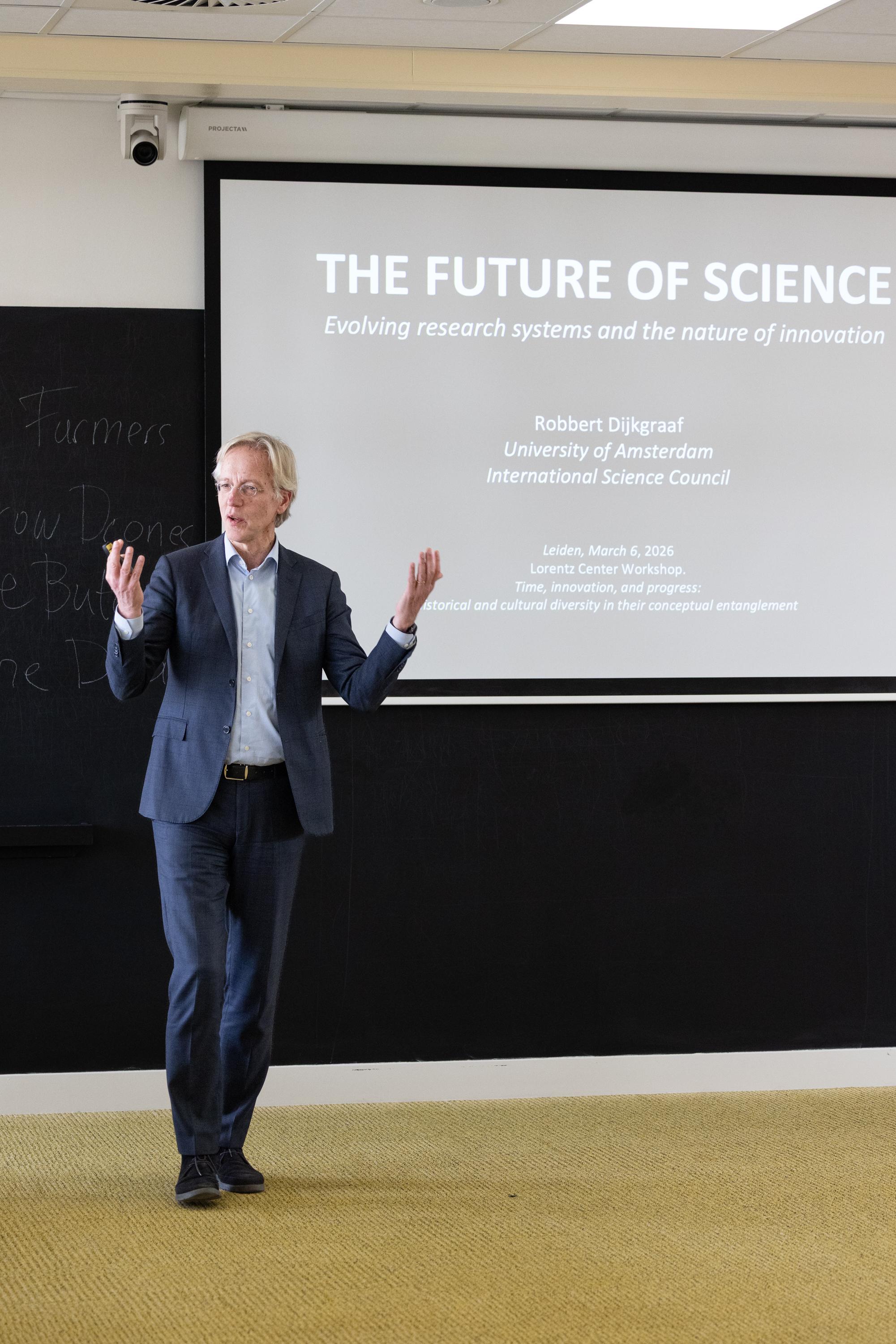
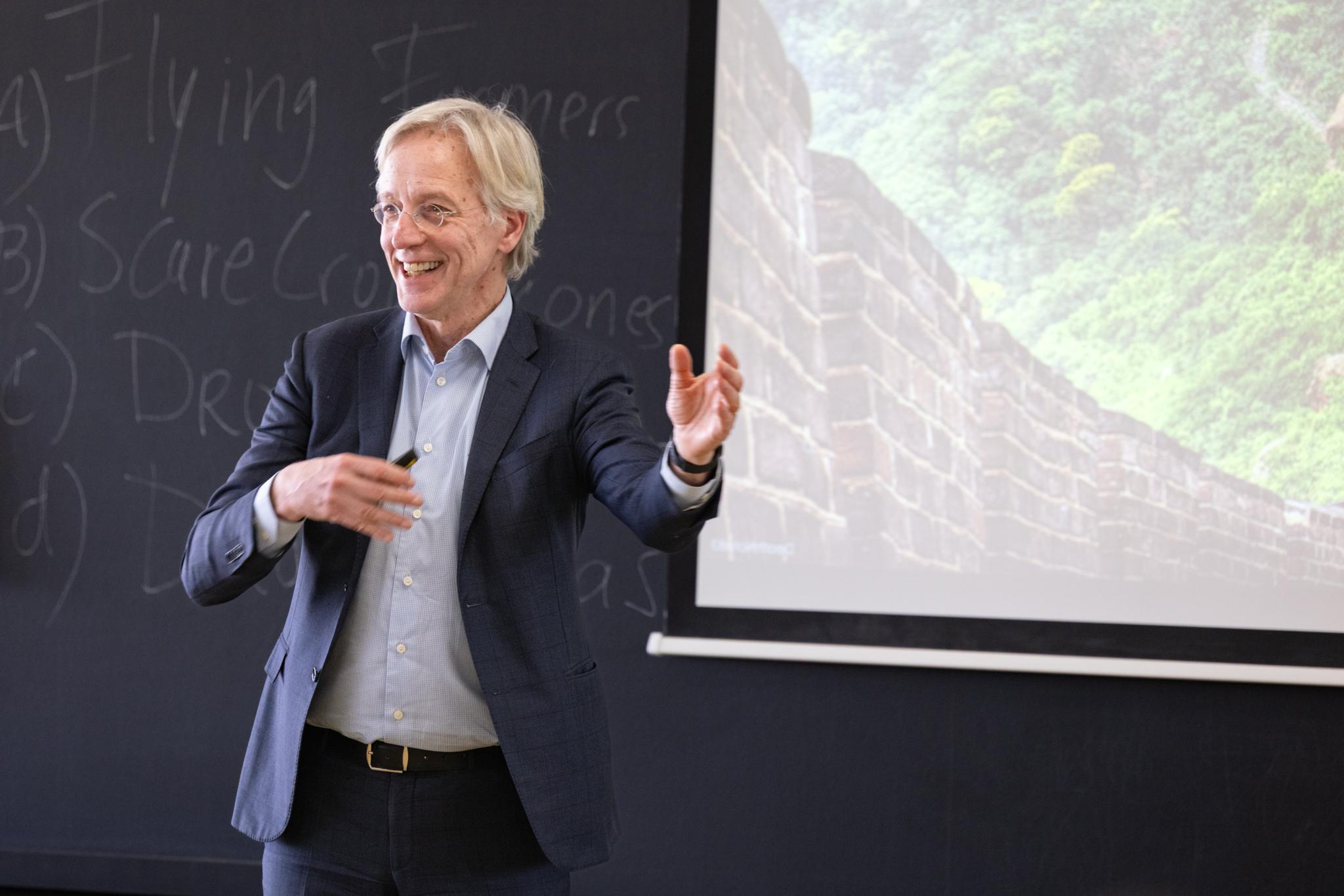
 Robbert Dijkgraaf’s public lecture concluded the Lorentz Center workshop with five days of intense discussions on time, innovation and progress. A fitting finale. With wit, historical anecdotes and a dose of intellectual provocation, the physicist, former Dutch Minister of Education and current president of the International Science Council, zoomed out from the workshop themes to a bigger question: where is science itself heading?
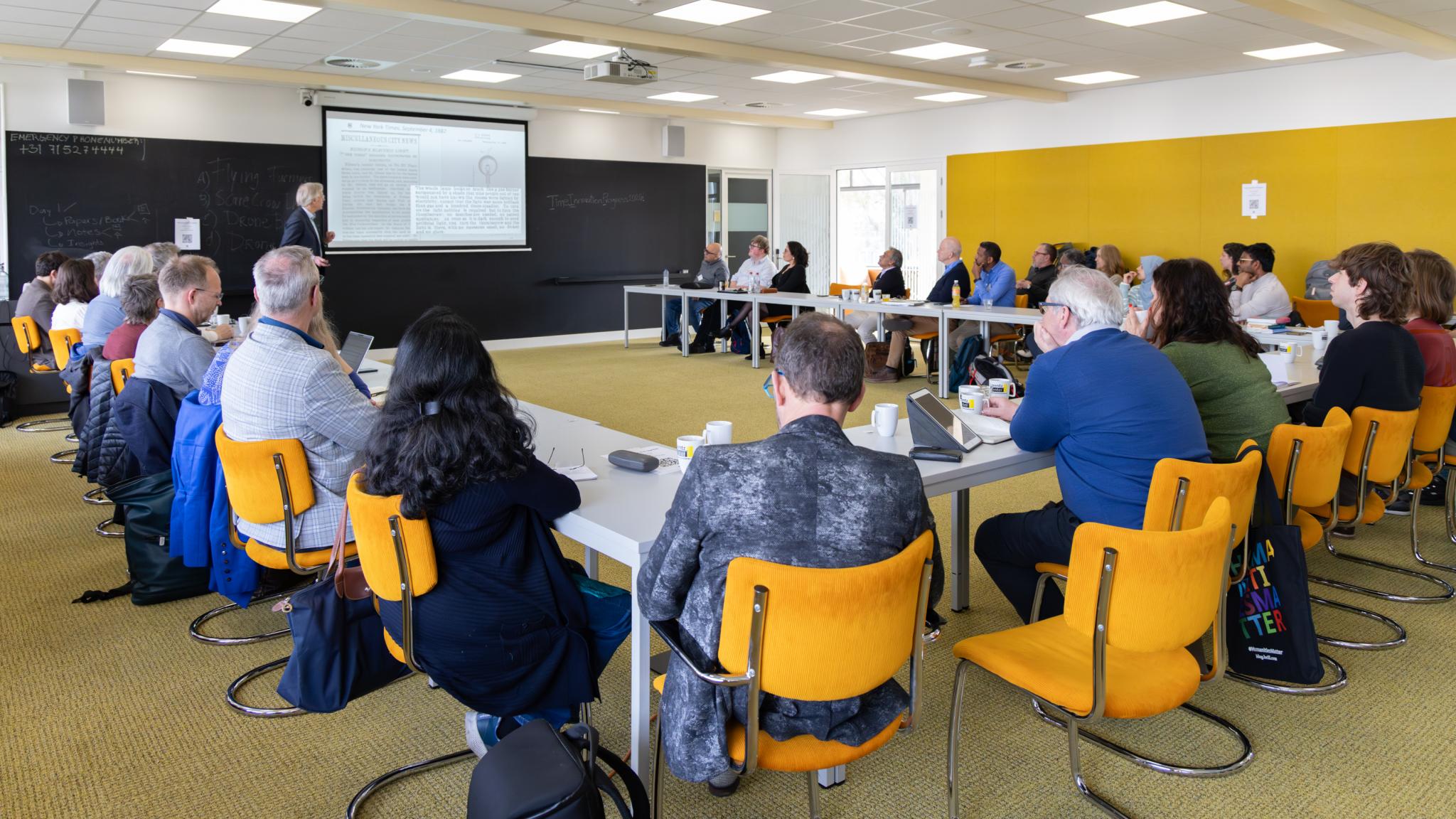
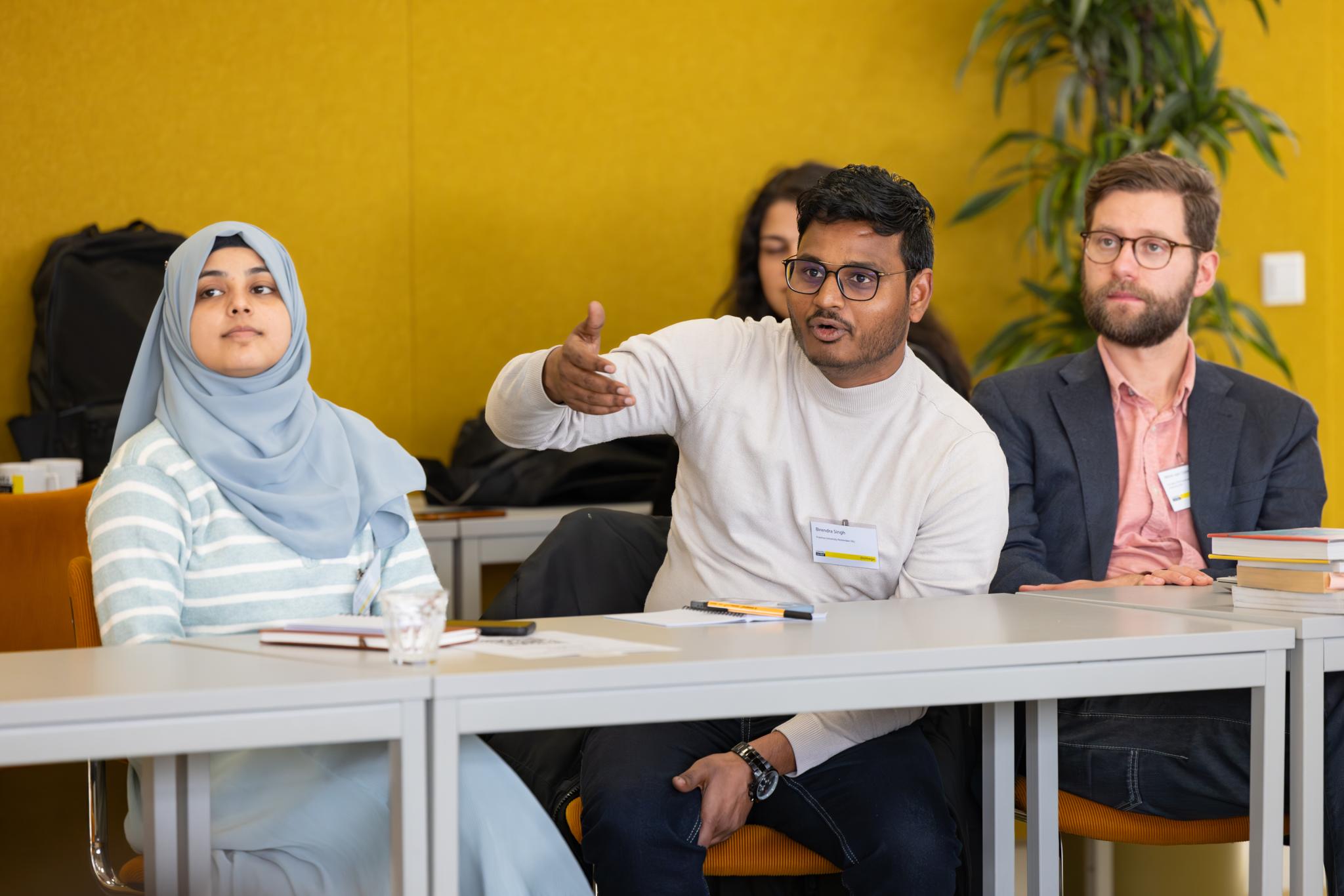
In the lecture hall at the Lorentz Center, scholars from different disciplines - engineers, historians, economists and social scientists - filled the room. After a week of debating the nexus of time, innovation and progress, Dijkgraaf’s lecture offered both a synthesis and a challenge. Looking back over more than a century of scientific innovation, he suggested that ideas of progress often unfold across longer historical arcs - something the workshop itself had explored by tracing innovation across time and space, even back to ancient Greece and Rome.
“We all feel that something fundamental is changing,” Dijkgraaf said. “But no one yet knows exactly where we are moving towards.” In his talk, he reflected on the role of science in a rapidly changing world. He moved effortlessly between examples from physics, history, politics and philosophy of science. But behind the anecdotes and humor was a serious message: science itself is entering a period of uncertain transition.
His promise to the audience was disarmingly modest. “I’m here to provide some light entertainment,” he joked at the start. “My aim is perhaps to challenge you a little - and maybe even bring you to a higher level of confusion.” For a room full of scholars who had spent the week wrestling with ideas of time, progress and innovation, that seemed like exactly the right starting point.
The long tail of curiosity
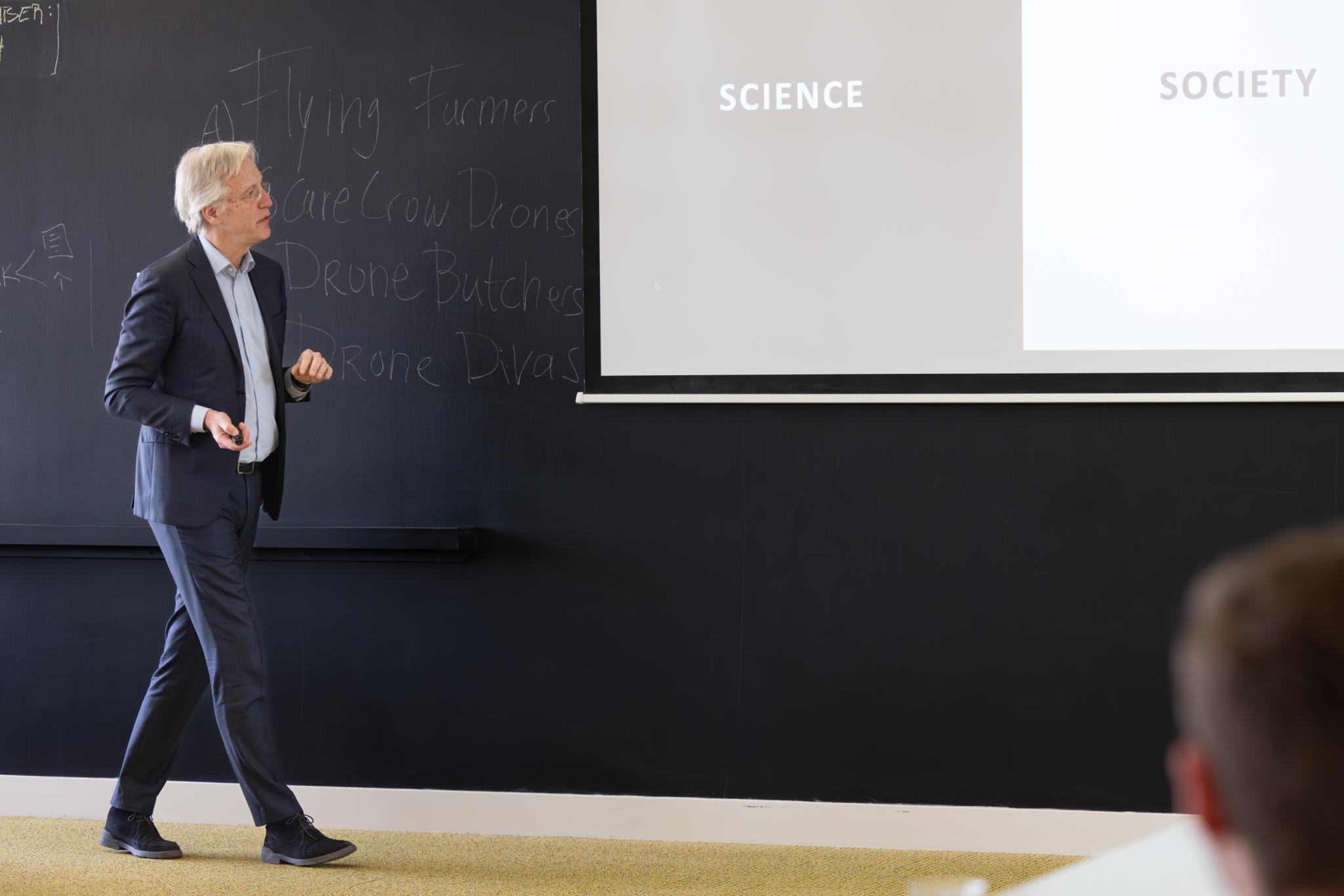
Dijkgraaf began by reminding the audience that the relationship between science and progress has never been straightforward. Scientific breakthroughs rarely look revolutionary at the moment they appear.
Take electricity. When Michael Faraday demonstrated early experiments, a visiting finance minister famously asked what practical use they might have. Faraday’s answer has become legendary. “One day,” he replied, “you may be able to tax it.”
At the time, it sounded like a joke. Today, electricity powers modern economies.
The same delayed recognition applies to many innovations. When Edison first demonstrated electric light in New York, the New York Times did not herald the beginning of a new technological era. Instead, it noted rather dryly that the lamp resembled a gas light — only without the smell.
“Innovation often takes a long time to sink in,” Dijkgraaf noted. “Transformative breakthroughs often come from the long tail of fundamental research.”
The pattern repeats across science. Quantum mechanics, first introduced by Max Planck in 1900 as what he called an “act of desperation”, now underpins large parts of the modern economy. “A humble estimate is that roughly 35 percent of our economy relies on quantum mechanics,” Dijkgraaf said. In the world at large “that’s probably closer to one hundred percent.”
“Curiosity-driven research often looks useless at first.
But it is precisely that kind of research that ends up transforming society.”
Progress and crisis at the same time
The lecture then shifted to a broader question. What does scientific progress actually mean in a world facing ecological and political crises?
Dijkgraaf presented two sets of graphs. One depicted rising life expectancy and economic growth. The other showing CO₂ emissions, environmental degradation and climate change. Both stories are true. “We live with two realities at the same time,” he said. “The world is improving in many ways, and deteriorating in others.”
That duality was central to the workshop itself. Scientific and technological innovation has brought enormous benefits, but it also raises profound questions about responsibility, direction and unintended consequences.
From discovering nature to designing it
According to Dijkgraaf, science is now entering a new phase. The twentieth century was largely about discovering the building blocks of reality: genes and molecules for life, atoms and particles for matter, bits and algorithms for information.
Today scientists are increasingly able to manipulate those building blocks directly. Gene editing, synthetic biology, quantum technologies and artificial intelligence are turning science into an engineering enterprise capable of creating entirely new configurations of life, matter and information. This fundamentally changes the landscape of research.
“In the past we explored what existed,” he said.
“Now we are exploring what can be created.”
“The space of what we can produce is vastly larger than the space of what we have discovered.”
Acceleration and uncertainty
Another striking feature of today’s research landscape are the speed and interconnectedness of changes. Scientific fields that once evolved relatively independently are now tightly interconnected. Quantum technology, new materials, artificial intelligence and biological engineering are reinforcing one another. Meanwhile, the amount of data produced by scientific research is growing at an astonishing pace.
“The data in the life sciences now doubles roughly every six months,” Dijkgraaf noted.
The result is a sense of acceleration that raises a simple but uncomfortable question. “If part of the world is stepping on the accelerator,” he asked, “who is stepping on the brake? And perhaps even more importantly - who is holding the steering wheel?”
Participants at the workshop had already discussed the need for slow innovation, within diverse rhythms of innovation allowing for reflection within technological development (and better alignment with rhythms of human life and nature). Dijkgraaf acknowledged that concern.
The limits of the academic system
Part of the challenge lies in how science is organised. Universities have traditionally structured knowledge into disciplines. That structure has produced enormous intellectual progress, but also barriers.
“The world has problems,” Dijkgraaf said. “The university has departments.” Climate change, public health or technological disruption do not fit neatly within disciplinary boundaries. Yet academic institutions still largely operate within those boundaries.
To address complex global challenges, Dijkgraaf argued, science must move beyond traditional interdisciplinarity towards transdisciplinary collaboration - involving policymakers, communities, industry, civil society and other knowledge holders. For Dijkgraaf, this is not an optional add-on. It is becoming a structural requirement for science. Knowledge does not reside in universities alone.
“The problem is not a lack of knowledge.
The problem is how knowledge connects to society.”
Science as an ecosystem
To rethink the system, Dijkgraaf suggested ecosystem as a metaphor. Instead of focusing only on individual researchers or disciplines, science should be seen as an ecosystem. In an ecosystem, health is not measured by a single tree, but by the resilience and diversity of the forest.
A healthy scientific ecosystem includes different roles: fundamental researchers, communicators, educators, policy advisors, interdisciplinary connectors and public intellectuals. Not everyone has to do everything. But the system must support all these functions.
Science under pressure
Despite its achievements, science itself is facing growing pressures.
Dijkgraaf pointed to several worrying trends: threats to academic freedom, geopolitical conflicts turning research into a strategic battleground, organised disinformation campaigns, and increasing political interference in scientific agendas. Also in many countries the humanities and social sciences are losing ground.
International scientific cooperation is particularly vulnerable. “Science has long been one of the few areas where global collaboration flourished,” he said. “But today it is increasingly seen through the lens of national security and economic competition.” In such a climate, maintaining open channels of international collaboration becomes both more difficult and more important.
At the same time, science faces a paradox. Research is becoming more influential in daily life, but also harder for the public to understand. Modern technologies shape our lives, yet very few people fully grasp how they work.
This paradox raises profound questions about trust, democratic oversight and the relationship between expertise and society.
“Science is moving infinitely far away from us in complexity,
while becoming infinitesimally close to us in everyday life.”
Trust and the human dimension of science
Contrary to common narratives, Dijkgraaf emphasised that trust in science remains relatively strong in many societies. Surveys show that scientists still rank among the more trusted professional groups.
But the picture is uneven. Trust is becoming increasingly polarised along political, educational and cultural lines. Scientific institutions often face more scepticism than individual scientists. Perhaps most importantly, people tend to trust scientists more when they acknowledge uncertainty and engage in dialogue. “Trust increases when scientists listen,” Dijkgraaf noted.
Becoming “barbarians”
Dijkgraaf closed his lecture with an unexpected metaphor drawn from Italian writer Alessandro Baricco. Baricco describes modern thinkers as “barbarians”: people who move across boundaries, explore unfamiliar territory and refuse to stay within established structures.
For Dijkgraaf, the metaphor offered a useful lesson for science. Researchers should not stay within the comfort of disciplinary spaces. “We should all be a little bit like barbarians,” he said. “Not too worried about borders. Just climb over them.”
The remark drew laughter from the audience, but the message was serious. If science wants to address complex global challenges, it will need to move more freely across boundaries - intellectual, institutional and societal. Dijkgraaf left the audience with the same ambiguity. In a world where science, society and technology are increasingly intertwined, the most important task may not be defending the boundaries of knowledge. It may be learning how to cross them.
Ending on a note of productive confusion
By the time the lecture ended, the room had been taken on a journey through the history and future of science. From Faraday’s electricity experiments to artificial intelligence and climate politics, Dijkgraaf’s reflections echoed many of the themes explored throughout the workshop.
Time, innovation and progress, it turns out, are not only questions of technology or history. They are also questions about how science itself evolves. And if the closing lecture achieved one thing, it was perhaps exactly what Dijkgraaf had promised at the beginning. A slightly higher level of confusion - but the productive kind that sparks new thinking.