


As part of the Leiden-Delft-Erasmus Minor Frugal Innovation for Sustainable Futures, we highlight the work of students who engage in interdisciplinary research on sustainable and inclusive solutions.  This month, we feature Eleni Roussopoulou, a third-year International Business Administration student at Rotterdam School of Management, Erasmus University. With a strong interest in sustainability, innovation, and human-centered leadership, she is currently conducting a three-month research internship on the AI Digital Technology Adoption Framework for Global South Communities.
This project is a joint collaboration between the International Centre for Frugal Innovation (ICFI), the University of Cambridge, and Santa Clara University.
Below, Eleni shares her first impressions and learning experiences from the early weeks of her research.
Three weeks ago, I began a 3-month research internship as part of my minor in Frugal Innovation for Sustainable Futures, focusing on AI Digital Technology Adoption Framework for Global South Communities. This joint research project with the International Centre for Frugal Innovation, University of Cambridge and Santa Clara University has already challenged everything I thought I knew about AI.
Like many students, my relationship with AI has been largely defined by warnings: "Don't use it for assignments," "It's plagiarism". We all know what ChatGPT is, but we were never taught the technology behind it, its evolution, or its broader implications.
Here's what these past three weeks have revealed:
The AI we interact with daily - Google Translate, Tesla Autopilot, facial recognition - is all Narrow AI, designed for specific tasks. What we don't realize is that General AI (AGI), the kind that could perform any human task, doesn't exist yet and remains 10-30 years away, purely theoretical.
Understanding the AI hierarchy has been eye-opening:
AI → Machine Learning (learns from data) → Deep Learning (neural networks) → Generative AI (creates content). Each layer builds on the last, yet most of us interact only with the final output.
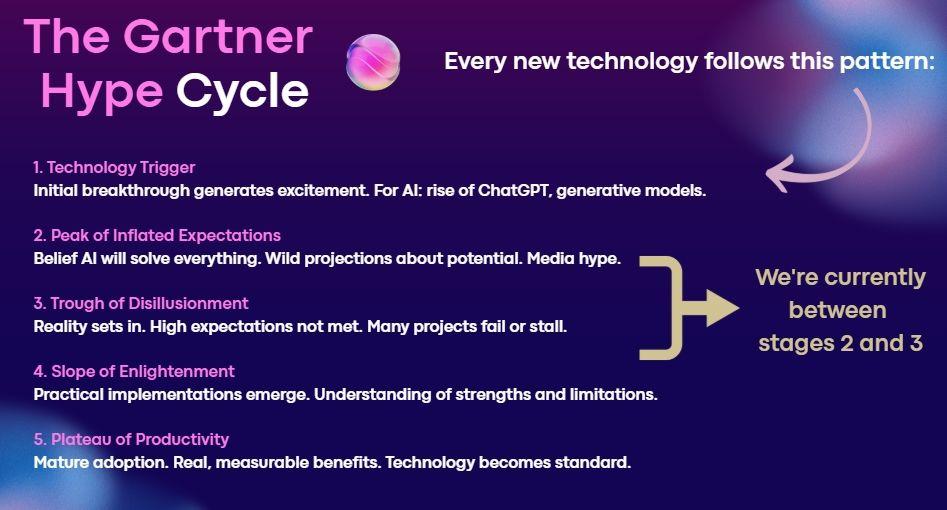
The Gartner Hype Cycle has helped me contextualize where we are: We've moved past the "Peak of Inflated Expectations" where AI was supposed to solve everything, through the "Trough of Disillusionment" where reality set in, and we're now climbing the "Slope of Enlightenment", understanding both AI's strengths and its very real limitations.
But here's what's most striking: the geographic flow of AI's benefits and burdens. While investment and profits concentrate in the US and Europe, the Global South bears hidden costs, from cobalt mining in Congo for AI infrastructure to Kenyan workers paid $2/hour labeling toxic content for ChatGPT. This isn't unique to AI; it's a pattern across tech industries that demands our attention.
With 2025 marking the global shift from AI planning to implementation, and governance frameworks finally taking shape worldwide, the timing of this research couldn't be more critical.
These three weeks have opened an entirely new world for me in understanding not just what AI is, but what it means for different communities across the globe.
So here's my question to you:
- How do we build AI systems that truly benefit everyone?
- Can we create models where the workers labeling data in Kenya earn fair wages and safe working conditions?
- Where local communities in the Global South aren't just data sources or cheap labor, but active participants and beneficiaries of AI innovation?
- Where AI helps solve region-specific challenges, from agricultural optimization to healthcare accessibility, rather than just serving markets that can afford it?
The technology exists. The question is: will we use it equitably?


