


 Pelle Grit – questioning impact through engineering
Pelle Grit is a final-year Mechanical Engineering student at TU Delft, driven by a strong interest in developing solutions to environmental and societal challenges. During his studies, he focused on climate systems, their impact on communities, and the role technology can play in addressing these issues. He will continue this path in a Master’s in Environmental Engineering.
In this blog, Pelle takes a critical look at the Paperfuge—a widely celebrated frugal innovation designed to make medical diagnostics more accessible. While the invention itself is ingenious, he questions whether its real-world impact matches the global attention it received. By doing so, he highlights a key tension within frugal innovation: the gap between promising ideas and actual implementation.
Are famed world-saving inventions more than a mirage?
Some clever inventions are glamourised in our media, but is this attention always deserved? A critical view on a frugal innovation.
You might have come across a documentary or article about an invention that uses clever insights to create something simple that makes the world a better place. These can be strokes of genius that are presented by the media as clever and altruistic. Rightly so, as often these inventions were made with the good intentions to really make a positive impact on our planet. But, what is the actual impact of these inventions? Are they as good as they are presented to be?
To be thrifty, sustainable, inclusive, impactful
There are many different types of innovation in this world. High precision machinery, AI development and renewable materials were all created with a different purpose, serving different markets. Quite recently, a new way of innovating came about. The innovations are relatively simple, require clever insight and aim to make this world a better place. In this blog we will be discussing a product in the branch of Frugal Innovation! But, what does it mean for an innovation to be “frugal”?
Frugal innovation centres on core values like resource efficiency, affordability, accessibility and sustainability. Oftentimes, frugal innovations are designed towards the lower-income population; the bottom of the pyramid. In order to serve these markets, the price of the product or service should not be too high. This coincides with the resource efficiency aspect. By using materials in an efficient manner, price and material waste can be reduced. This is often done by using resources that are in abundance in a specific context. Think about things like plant waste manufactured into building bricks and plastic bottles turned into 3D printable material. One other important aspect is the communication with those for whom the product is designed. By being knowledgeable about the local context, the product can be designed specifically, making as much impact as possible.
Attaining these values makes an innovation frugal, aimed towards having a positive impact on the world. A more specific example of a frugal innovation is the Paperfuge, invented by Manu Prakash. Let’s take a good look at the successes and failures of this product.
The genius of the Paperfuge
Manu Prakash is a professor at Stanford. He is the founder of the Prakash Lab. A place where he, along with his team, develop many projects attaining the frugal innovation values. These developments often include field trips to gain more local contextual knowledge.
On one of these trips, he went to rural Uganda and visited a medical facility to research the detection of schistosomiasis. During this visit, he noticed something peculiar. In one of the clinics a centrifuge was used as a doorstop. This was striking as these devices are worth thousands of euros, and are a crucial tool for diagnosis with blood samples. When inquiring about this doorstop, he was told this donated device was basically a piece of junk, as they had no electricity available there. This was the start of the thinking process and development of a new invention; The Paperfuge.
For example, in order to diagnose malaria you need to separate blood before inspecting the sample for infection. This is done by spinning the sample extremely fast, letting centrifugal forces separate the blood plasma. Manu Prakash researched many spinning objects until he came across a well-known toy, “a button on a string” (also known as whirligig or buzzer). By continuously pulling and letting go of two strings, a cardboard circle attached in the middle of the two strings will start to spin, reaching speeds up to 120,000 RPM. Using the workings of this toy, the final product was created. With 15 minutes and 18 cents to spare, you could now separate blood without needing electricity. Genius.
Glamourised innovation
The invention was created and released to the world! As an open-source project anybody could produce this new, though simple, piece of technology. The invention quickly blew up in the media. The Paperfuge got awards, many articles were written about it and video interviews got millions of views. Seemingly, this invention would solve diagnosis problems for many, many people. But, what is the actual impact the Paperfuge has had? When reading articles, many don’t even mention this aspect of the project! While arguably, this is the most important measurement of success.
As Manu Prakash himself mentioned in his TED-Talk, introducing the Paperfuge to local communities is by far the hardest part of the process. Only by spreading awareness and bringing this product into the market can this product change people's lives. Persuading the right people that the product works can not be done by just texting them, it is way more effective to do this in person. It just isn’t that easy to convince others that an 18 cent toy can do as much as it can.
Manu and his team were able to bring the Paperfuge to some medical facilities in Madagascar by going there physically, but this is where most distribution came to a stop. There are no recent articles available about larger implementations of the Paperfuge, the concept was not able to reach the masses. This makes the actual impact lower than most might expect. Ironically, I estimate far more “Western” people know about the Paperfuge, than those who it was designed for…
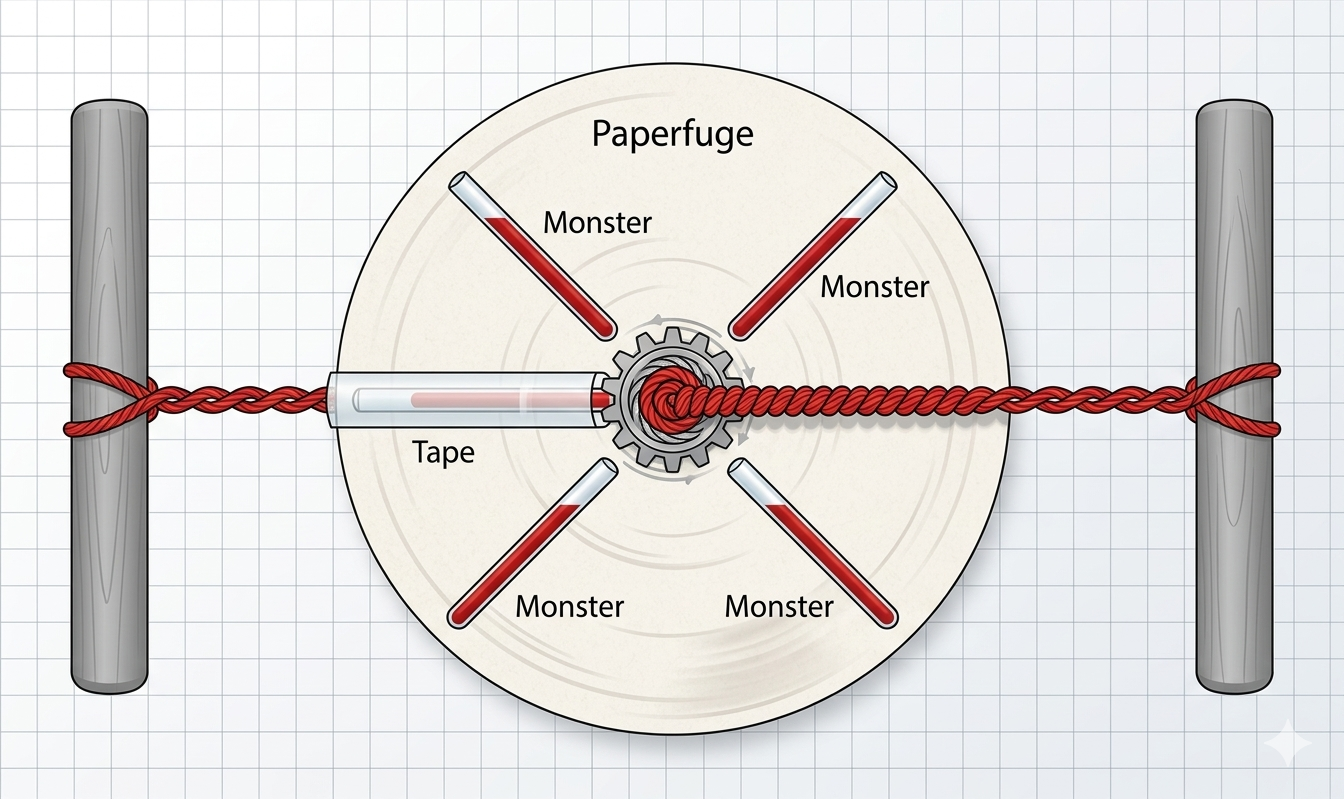
Illustration of the paperfuge
A world of inventions
Does this mean the Paperfuge is a failed product? Is it wrong that the media might have glamourised this product more than it should have? No. My point is not to bash on the Prakash Lab or reprimand those who were captivated by articles or videos. The Paperfuge did more than just make a positive impact on some communities. It inspired many people to innovate in a Frugal way, attaining the values this branch of innovation treasures. The point that I am trying to make is that being critical is important, especially when western culture glamourises something a little too much. They are not the ones to say if a product actually improves lives, better ask the people it was designed for.
Frugality: A tough business
I want to end this blog by briefly discussing possible solutions for the bottleneck of distribution, and spreading awareness. We can compare the Paperfuge to another invention produced by the Prakash Lab: the Foldscope. This product is also a cheap and accessible alternative for a medical device, a microscope in this case. This innovation was widely celebrated by the media too, and actually was the predecessor of the Paperfuge. However, this product was able to reach the masses. Why was an invention so similar that much more successful? What is the key difference between the two?
The main difference lies in the institutionalisation of the project. The Foldscope has created a business for itself that is self-sustaining. This business created a drive for people to maintain the distribution of the product, creating more impact. The Paperfuge was not able to take the same path for several reasons. Being extremely cheap, profit margins are extremely low, making it hard to build a business around it. Additionally, the Paperfuge is aimed at the most rural communities that are very hard to reach, making the cost and effort of distributing physical products relatively high.
However, spreading only the concept of the Paperfuge does not have to be that expensive.
If you were to invest in incentivising locals to start manufacturing Paperfuges themselves, the work of manufacturing, distributing and promoting will be done by them. In addition to increasing the positive impact of the Paperfuge greater, this can support local economies too. This was not possible for the Foldscope, as elements of the product are much harder to get your hands on than some cardboard and a piece of string. This indirect way of institutionalising a project could be a solution to spreading a genius product like this to hard-to-reach places.
Right now, the Prakash Lab is still developing new versions of the Paperfuge, and new strategies of distribution. The future of this innovation is definitely not yet set in stone. And who knows, maybe the actual impact of the Paperfuge will grow even larger than any form of media could have ever predicted.